· by
David Wexler
Embedded Finance
,
Banking APIs, API Integration
Business customers live in ERPs and accounting software. Banking APIs for embedded finance keep your bank or credit union essential inside those workflows.
For decades, banking was simple. Customers interacted through online banking or they visited branches. Financial institutions owned the experience because they owned the destination.
That model no longer reflects how business actually operates.
Today, commercial and corporate customers run their daily operations inside ERP systems, accounting platforms, and vertical software. That is where money moves, decisions are made, and access is controlled. When banking requires customers to leave those environments and log into a separate portal, institutions become disconnected from real business activity and increasingly risk becoming an interchangeable utility.
Embedded finance is the response to this shift. But for banks and credit unions, embedded finance is not a product feature or a fintech experiment. It is a distribution strategy that determines whether the institution remains essential to customers’ operations or fades into the background.
Business outcome
Institutions that align banking with real workflows deepen relationships, grow sticky deposits, and increase transaction volume without expanding physical channels.
Embedded Finance Needs to Be Practical for Banks
Embedded finance is a widely used term, but it often lacks clarity when banks try to execute.
In practice, institutions are not asking for abstract embedded finance strategies. They are asking straightforward questions. How can customers see balances inside their ERP? How can payments be initiated without handing out online banking credentials? How can access be controlled in a way that satisfies auditors and regulators?
What banks really want is a simple way to let partners and business customers connect to their banking systems without giving up control.
This is where the concepts of embedded finance, embedded banking, partner banking, and banking APIs come together. Embedded finance describes the market shift. Embedded banking describes the experience customers expect. Partner banking describes the strategy banks must adopt. Banking APIs are the capability that makes it real.
When these elements are treated separately, initiatives stall. When they are aligned, embedded finance becomes operational and scalable.
Business outcome
Clear execution models reduce risk, shorten time to market, and turn embedded finance from theory into results.
From Banking as a Service to Partner Banking
Many institutions first encountered embedded finance through early banking-as-a-service models. Those approaches promised speed by outsourcing integration and program management to third parties.
Over time, the limitations became clear. When banks do not manage their own programs, visibility and control erode. Compliance risk increases. Regulators reinforce a simple truth. Accountability cannot be outsourced.
The next evolution is partner banking.
In a partner banking model, the bank owns the integration layer. The institution defines which capabilities are exposed, who can access them, and under what conditions. Partners and platforms integrate through approved, governed interfaces rather than opaque intermediaries.
This approach allows banks and credit unions to expand distribution while maintaining ownership of compliance, data, and customer relationships. It also opens the door to the most compelling opportunity in embedded finance: enterprise and platform integration, not just fintech sponsorship.
Business outcome
Partner banking enables sustainable growth while preserving regulatory confidence and institutional control.
Banking APIs Are the Foundation
Embedded finance does not scale without APIs. But point integrations and custom builds create complexity rather than opportunity.
Banks need reusable, governed APIs that sit between the core and the outside world. APIs that expose accounts, payments, and data as standardized capabilities. APIs that can be monitored, approved, and reused across multiple partners and workflows.
At PortX, these are delivered through ORCA APIs, or Open Reusable Core APIs. ORCA APIs expose accounts, payments, and data through a consistent, secure interface that institutions control. Partners and platforms connect once and build faster, while governance remains centralized.
APIs alone are not enough. They must be paired with authentication, access control, documentation, and monitoring, all managed from a single platform. This is how embedded finance becomes repeatable instead of fragile.
Business outcome
Reusable banking APIs lower integration costs while enabling new distribution and revenue opportunities.
Embedded Banking Inside the ERP Is Where Value Becomes Real
The most practical embedded finance use case today is banking inside the ERP.
Most commercial customers manage cash flow, approvals, vendors, and payments inside an ERP or accounting system. Traditionally, completing a transaction required leaving that system to log into online banking, creating friction and security risk.
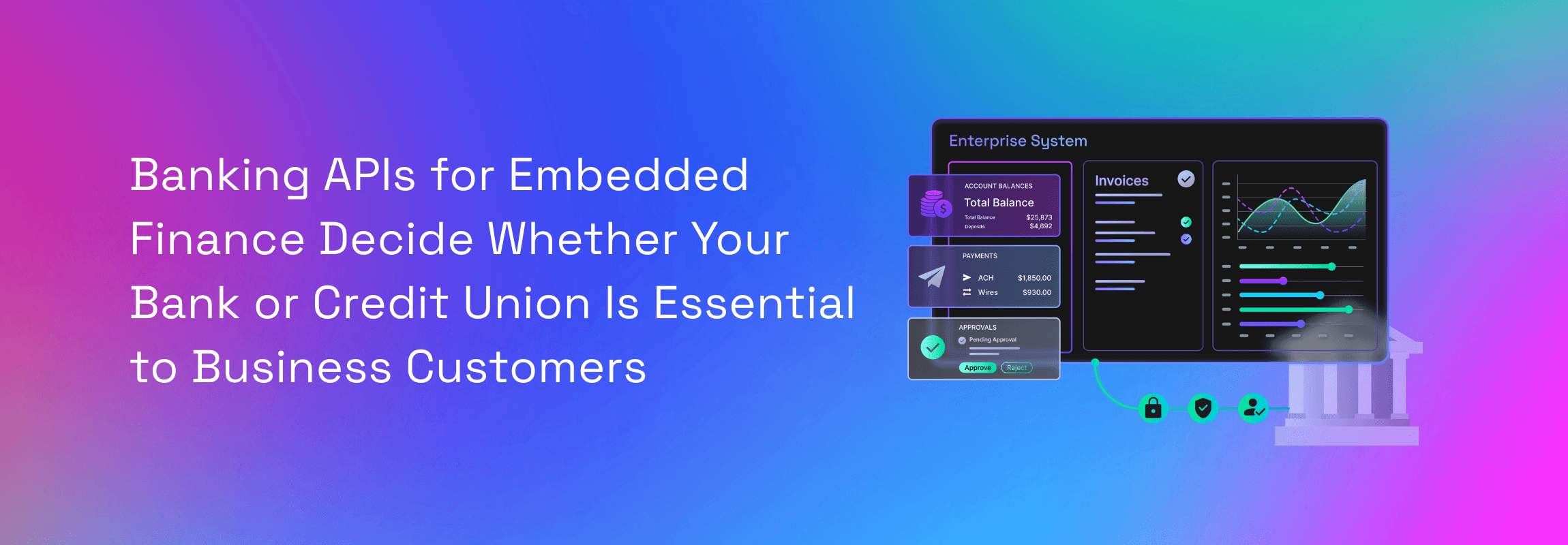
Embedded banking changes that. Account balances, transaction history, ACH, and wire initiation appear directly inside the ERP. Access aligns with enterprise role-based permissions. When employees are onboarded, offboarded, or change roles, access updates automatically.
For the institution, the benefits are tangible. Funds remain on balance sheet because money must be there to operate. Payment activity increases because the bank becomes the default path for transactions. The relationship becomes operationally embedded, not just contractually defined.
Business outcome
Embedded banking in ERPs increases deposit retention, transaction volume, and customer stickiness.
Governance Turns Embedded Finance Into an Advantage
Speed alone does not win in embedded finance. Trust does.
Banks and credit unions bring regulatory expertise, risk management, and governance that technology platforms cannot replicate. When paired with modern integration and data platforms, those strengths become competitive advantages.
Embedded finance requires centralized control. Institutions must manage access, monitor usage, and enforce compliance from a single platform as partners, volumes, and use cases grow. When integration and data are unified, visibility improves and complexity decreases.
This is how embedded finance scales safely.
Business outcome
Strong governance enables growth without increasing operational or regulatory risk.
Embedded Finance Is About Staying Essential
Embedded finance reflects how businesses already operate.
When banking services live inside the systems customers rely on, the institution becomes part of daily operations rather than a destination customers work around. Funds stay put. Payments flow naturally. Relationships become harder to replace.
Institutions that invest now position themselves as platforms for commerce and growth. Those that wait risk becoming interchangeable utilities behind someone else’s interface.
At PortX, we help banks and credit unions unify integration and data so they can deliver embedded finance with confidence. Through ORCA APIs and a single platform for governance, institutions maintain control while expanding distribution.
Embedded finance, done right, keeps banking essential.
If you would like to learn more about how PortX helps financial institutions deliver embedded finance through secure, reusable ORCA APIs, explore our embedded finance solution and start a conversation with our team today.



1.833.667.6789
hello@portx.io