

































PiXi AI
Agentic AI for faster integration and intelligence.
PiXi is the AI foundation of the PortX Platform, giving financial institutions enterprise-grade power without armies of specialists, custom code, or heavy infrastructure. It accelerates integration, simplifies data governance, and delivers instant insights through natural language. Purpose-built for financial services, PiXi ensures secure, compliant, and future-ready intelligence across your institution.
Key Features
Instant trusted insights from natural language queries
AI-powered data mapping cuts project timelines by 40%
Automation and orchestration that streamlines workflow
Compliance-first design that’s secure, governed, and auditable for FIs.
PiXi is embedded across integration, data, and payments.
Key Features
Reusable API Specification – One universal API for common banking use cases.
Portable & Standards-Based – JSON/REST APIs aligned with ISO 20022, CUFX, and FDX.
Compliance & Security – Secure, governed, and auditable access to core data.
ORCA™
Universal, portable connectivity to banking cores.
ORCA™ (Open Reusable Core API) is our universal data model and standardized API specification for connecting financial institutions, fintechs, and applications to core systems. Delivered as part of Integration Manager, ORCA replaces custom, one-off integrations with a single reusable API that works across all major cores. The result: faster fintech adoption, simplified core changes, and reduced risk—powered by consistent, standards-based connectivity.
One platform. One industry. All Use Cases.


Our latest blogs:
Stablecoin Regulation for Banking: How Governed Architecture Becomes Competitive Advantage
Kent Brown
With the passage of the GENIUS Act, payment stablecoins moved from regulatory ambiguity into a defined federal framework. Reserve requirements, disclosure standards, compliance expectations, and restrictions on issuer-paid yield now shape how stablecoins operate in the United States.
Additional details continue to evolve through related digital asset legislation, including the Digital Asset Market Clarity Act of 2025. The direction is clear, even if certain lines are still being refined.
For banks and credit unions, this is a meaningful shift.
Digital money is no longer confined to operating at the edge of the regulated system. It is increasingly being embedded into it.
But regulatory clarity does not eliminate operational complexity. It raises the bar for governance, integration discipline, and real-time oversight. Article 2 examined the economics. This article focuses on what comes next: the supervisory structure, risk considerations, and architectural discipline required to operationalize digital rails with confidence.
What the GENIUS Act establishes
At a high level, the GENIUS Act requires payment stablecoins to:
Maintain one-to-one reserve backing with high-quality liquid assets such as cash and short-term Treasuries
Provide regular public disclosures and reserve audits
Comply with bank-grade KYC and AML requirements
Support lawful enforcement controls, including freezing or burning tokens under court order
Avoid issuer-paid yield as part of the stablecoin design
The intent is straightforward. Stablecoins are positioned as payment instruments, not investment vehicles or deposit substitutes.
Token holders may still earn yield through third-party arrangements, but the issuer does not pay that yield.
This structure reduces the likelihood that stablecoins directly compete with FDIC-insured savings products. It reinforces their primary function as a settlement mechanism.
For executives, the takeaway is this: stablecoins are now regulated infrastructure. That makes them more viable. It also makes them more accountable.
Stability, confidence, and liquidity management
Reserve backing is essential. It is not sufficient on its own.
Stablecoins are designed to be pegged to the U.S. dollar. In practice, pegs can experience short-lived deviations based on market confidence and liquidity dynamics. Well-regulated issuers mitigate this through transparent reserve reporting and disciplined liquidity management.
From an institutional perspective, confidence is the critical variable.
If redemption demand rises suddenly, liquidity planning determines whether the peg remains stable. Institutions interacting with stablecoins must understand:
Counterparty reserve composition
Redemption mechanisms
Intraday liquidity exposure
Transaction velocity monitoring
The GENIUS framework reduces structural fragility compared to unregulated models. It does not remove the need for active risk management.
For CIOs and risk leaders, this is an architectural consideration. Monitoring must be real-time. Reconciliation must be automated. Visibility must extend across systems.
Continuous settlement requires continuous oversight
Traditional payment rails operate within predictable windows. Batch processing and cutoff times create natural review intervals.
Stablecoins operate continuously.
Transactions can settle at any hour. Liquidity moves without regard to business day boundaries. Monitoring cannot rely on end-of-day reconciliation.
Institutions must ensure:
Real-time transaction visibility
Automated AML screening
Unified audit trails
Integrated compliance reporting
Digital rails do not slow down for governance. Governance must operate at digital speed.
This is where integration and data become inseparable from compliance.
Supervisory contrast: stablecoins and tokenized deposits
Understanding regulatory structure is critical for strategic positioning.
Stablecoins operate under reserve-backed issuer requirements. They are typically liabilities backed by segregated high-quality assets. Their supervisory focus centers on reserve adequacy, transparency, and redemption discipline.
Tokenized deposits operate under traditional deposit supervision. They remain on the bank's balance sheet, fall within existing capital and liquidity frameworks, and are insured within FDIC limits.
This difference matters for boards and regulators.
Stablecoins modernize payment rails through reserve-backed digital tokens. Tokenized deposits modernize settlement while preserving traditional liability classification.
Both models require oversight. They do so under different supervisory constructs. Article 4 explores tokenized deposits in depth, including why many community institutions may find them to be the more natural starting point.
Regulatory readiness as competitive advantage
Community banks and credit unions already operate within rigorous supervisory frameworks. That experience is not a burden in the digital era. It is an asset.
Institutions that embed compliance into integration architecture can:
Reduce operational risk
Accelerate innovation
Demonstrate control to regulators
Build trust with fintech partners
Digital money does not reward improvisation. It rewards disciplined architecture. And institutions that have spent years building compliance muscle are better positioned than they may realize.
The question is not whether community banks can compete in the digital money era. It is whether they can act on the structural advantage they already have.
Are you architecturally ready?
Before engaging with digital rails, institutions should honestly assess their current foundation:
Integration and data visibility. Can you monitor transactions across all payment rails in real time with unified, governed access to that data across systems, or do you rely on batch reconciliation, end-of-day reporting, and multiple disconnected sources to piece together a complete picture?
Compliance automation. Are AML screening and exception workflows embedded into your payment logic, or are they manual processes that would not scale to 24/7 settlement?
Extensibility. Can your current integration architecture add a new payment rail without a major rewrite of core logic?
Institutions that can answer yes to all three are well-positioned to move quickly. Those with gaps have a clear roadmap for where to invest before digital money becomes operationally urgent.
Interoperability and evolving standards
Digital asset regulation continues to evolve globally. Jurisdictional differences persist. Interoperability between public and permissioned networks remains in development.
Executives should expect continued refinement of:
Reporting standards
Cross-border supervisory coordination
Digital asset custody frameworks
Technical integration guidelines
The regulatory trajectory favors clarity and integration rather than prohibition. Institutions that build flexible, open architectures will adapt more easily as standards mature.
Architecture as risk control
Compliance in the digital money era is not a static checklist. It is a systems design challenge.
Institutions need platforms that unify:
Integration across blockchain and traditional rails
Real-time data visibility
Role-based access controls
Automated monitoring and exception handling
When integration and data are fragmented, oversight becomes reactive. When they are unified, governance becomes proactive.
The executive perspective
Regulation has moved stablecoins from ambiguity into structure. Tokenized deposits provide a bank-native digital alternative. Both models are increasingly relevant.
The opportunity is real. The responsibility is greater.
Institutions that understand supervisory nuance, embed governance into architecture, and maintain control over integration will modernize safely.
Those who treat digital rails as peripheral may struggle to scale responsibly.
Digital money is not outside the regulated system. It is becoming part of it. And the institutions with the strongest compliance foundations are the ones best equipped to lead.
In our next article, we’ll examine tokenized deposits in depth and explore why many banks and credit unions may see them as the most natural path into blockchain-based settlement.
If you would like to learn more about how PortX helps financial institutions build regulated, digital-ready architectures, including governed integration and real-time compliance visibility across all payment rails, start a conversation with our team today.
Digital Money Economics: How Stablecoins and Tokenized Deposits Modernize Bank Payment Rails
Kent Brown
For decades, banks and credit unions have optimized their operating models around familiar payment rails. Cards generate interchange revenue. ACH supports recurring and batch flows. Wires handle time-sensitive or high-value transfers. Correspondent networks move funds across borders.
These systems are mature, they scale reliably, and are embedded in risk frameworks and balance sheet planning. But they were designed for a different economic era.
Today’s environment is defined by always-on commerce, embedded finance, and software-driven liquidity management. Settlement windows measured in days increasingly feel outdated. Reconciliation friction translates directly into cost by increasing back-office labor, prolonging cash positioning cycles, and eroding margin through manual exception resolution.
This article provides a strategic economic framework to help bank and credit union executives navigate how stablecoins and tokenized deposits reduce legacy friction, accelerate liquidity velocity, and prevent fintech disintermediation of the customer relationship.
The real cost of legacy rails
Legacy rails are effective, but also layered.
A typical card transaction involves issuing banks, acquiring banks, processors, and networks. Each layer extracts value. For merchants, interchange can range from 2% to 3% per transaction. For institutions, card programs generate revenue but also introduce fraud exposure, dispute management overhead, and settlement delay.
Cross-border wires compound the cost further. Correspondent banking relationships introduce multiple intermediaries. Foreign exchange spreads and fees accumulate. Settlement may take days. Liquidity remains trapped in transit.
ACH remains efficient for domestic recurring flows, yet it operates in batch cycles with cutoff times and potential reversals. For use cases that demand immediacy, that structure introduces friction.
These were designed for a different operating model and can be more expensive or less adaptable than digital-native alternatives in specific scenarios.
The economic question centers on where digital rails deliver greater efficiency and strategic advantage than legacy infrastructure.
How stablecoins alter payment economics
Payment stablecoins are pegged to the U.S. dollar and backed one-to-one by high-quality liquid assets such as cash and short-term Treasuries. Under the GENIUS Act framework, issuers must maintain reserve transparency, comply with bank-grade KYC and AML standards, and avoid issuer-paid yield.
From an economic standpoint, stablecoins introduce three shifts:
Settlement finality can occur in near real time. Funds move continuously rather than through batch windows.
Transactions may bypass correspondent layers in certain cross-border scenarios, reducing intermediary costs.
Built-in business rules enable conditional transfers and automated reconciliation, reducing manual intervention.
In use cases such as cross-border payouts, B2B treasury movements, marketplace settlements, and embedded financial products, these characteristics can materially reduce cost and accelerate liquidity cycles.
However, stablecoins are not universally cheaper. Institutions must manage liquidity, monitor redemption dynamics, and maintain integration controls. Economic gains depend on orchestration and governance.
Stablecoins can introduce efficiency potential but require discipline to capture it.
Liquidity velocity and funding implications
One of the most important, yet least discussed, economic effects of digital rails is liquidity velocity.
Real-time settlement compresses funding cycles. Businesses gain faster access to working capital. Treasury teams reduce idle balances. Intermediary float diminishes.
For banks and credit unions, this compression changes liquidity behavior. Even without issuer-paid yield, stablecoin adoption may increase the speed at which funds enter and exit the institution. That does not automatically create instability. It does require more precise liquidity forecasting and monitoring.
Executives should consider:
How digital rails affect intraday liquidity
Whether faster settlement reduces fee income in certain channels
How deposit composition may shift over time
Stablecoins and tokenized deposits are transactional digital money models. They are not designed to replace traditional deposits, yet the speed at which money moves across these rails can influence funding patterns. Understanding the velocity effect is critical for CIOs and CFOs alike.
Competitive pressure and customer control
The most significant economic risk, however, may not be transaction cost; It may be strategic control.
Fintech platforms are building payment experiences directly on digital rails. They abstract complexity from the end user. They embed financial functionality into software workflows.
If a fintech controls routing logic, wallet experience, and payment flow design, the financial institution could lose visibility into customer behavior unless it serves as issuer, custodian, or integrated settlement partner.
That is not disintermediation in the pure sense. The bank is still present. It is less visible. Over time, interface control influences pricing power, data ownership, and customer loyalty. Institutions that ignore digital rails risk allowing fintechs to define the operating model around them.
Institutions that engage can preserve relevance while maintaining regulatory authority.
Tokenized deposits and balance sheet alignment
Stablecoins are one digital money model. Tokenized deposits represent another.
Tokenized deposits are traditional bank deposits recorded and transacted on distributed ledger technology. They remain on the bank’s balance sheet, operate within existing capital and liquidity frameworks, and are insured within FDIC limits.
From an economic standpoint, tokenized deposits preserve funding classification while modernizing settlement mechanics.
This distinction matters.
Stablecoins sit adjacent to deposits. They are backed by reserves and restricted from issuer-paid yield. Tokenized deposits are deposits. They support lending capacity and integrate directly into margin and reporting systems.
For many community banks and credit unions, tokenized deposits represent a lower-friction path into digital settlement.
Stablecoins may excel in open ecosystem interoperability and fintech-driven flows. Tokenized deposits may dominate interbank and institutional settlement use cases.
The economic calculus differs across models.
Feature | Stablecoins (GENIUS Act) | Tokenized Deposits |
Balance Sheet | Adjacent to deposits (Reserves) | On-balance sheet (Direct) |
Yield | Restricted/No issuer-paid yield | Supports interest-bearing models |
Insurance | Backed by HQLA/Treasuries | FDIC insured (within limits) |
Primary Use | Cross-border/Open ecosystems | Interbank/Institutional settlement |
Strategic evaluation framework
Executives should evaluate digital money economics across four dimensions.
Cost efficiency. Where do digital rails materially reduce intermediary expense?
Liquidity impact. How does real-time settlement alter funding cycles and balance sheet management?
Competitive control. Who owns the routing logic and the customer interface?
Regulatory alignment. Which digital model integrates most cleanly into supervisory expectations?
Digital money is a structural reconfiguration of settlement economics.
Integration architecture as economic leverage
Institutions that capture value from digital money will not be those that simply connect to a new rail. They will be the ones that orchestrate multiple rails within a unified architecture.
Stablecoins, tokenized deposits, ACH, RTP, wires, and cards must coexist. Routing should be policy-driven. Data visibility must be real time. Monitoring must be continuous. Without architectural discipline, each new rail adds complexity instead of efficiency.
With the right foundation, digital rails become economic leverage.
A unified, API-led approach allows institutions to treat stablecoins and tokenized deposits as additional settlement rails within a centrally controlled framework. Blockchain networks connect through standardized integration layers, data remains governed across all flows, and monitoring and routing are automated within defined compliance boundaries.
The PortX Platform reflects this model by unifying integration, data, and payments into a secure, AI-powered foundation built specifically for financial institutions. The objective is architectural control, ensuring digital money strengthens margin, liquidity management, and customer ownership rather than fragmenting them.
The executive takeaway
Digital money rails are evolving components of regulated financial architecture.
Stablecoins introduce new cross-border and ecosystem efficiencies. Tokenized deposits preserve balance sheet continuity while modernizing settlement. Both influence cost structures, liquidity dynamics, and competitive positioning.
The opportunity is measurable. The risk is strategic inaction.
Financial institutions that evaluate digital money through an economic lens, versus a headline lens, will position themselves well to modernize with confidence.
In our next article, we examine supervision, regulatory nuance, and the operational discipline required to scale digital rails responsibly.
If you would like to learn more about how PortX helps financial institutions modernize payment economics through AI-powered integration and governed data, start a conversation with our team today.
Stablecoins 101: What Every Bank Leader Needs to Know Post-GENIUS Act
Kent Brown
Why stablecoins suddenly matter
Stablecoins have moved from the fringe of crypto conversations into the center of U.S. financial policy. With the passage of the GENIUS Act, the federal government has drawn a clear line around how stablecoins can operate, who can issue them, and why they matter to the future of payments and banking.
That clarity, however, is not complete. Additional details are still being shaped through related legislation, including the Digital Asset Market Clarity Act of 2025. Together, these efforts signal direction and intent, even as some regulatory boundaries remain to be finalized.
For banks and credit unions, this moment is not about speculation. It is about infrastructure. Stablecoins represent a new digital form of the U.S. dollar, operating on always-on rails, settling in near-real time, and governed by a defined regulatory framework. That combination changes the competitive landscape for payments, deposits, and fintech partnerships.
This article is the foundation of our series. It explains what stablecoins are, what changed with the GENIUS Act, and why financial institution leaders should treat stablecoins as a strategic capability rather than a passing trend.
What is a stablecoin, in practical terms
A stablecoin is a digital token that is designed to be pegged to the value of a fiat currency, most commonly the U.S. dollar. Unlike volatile cryptocurrencies, payment stablecoins are backed by reserves held in cash or short-term U.S. government securities. The crucial requirement is that these reserves must be liquid or easily (and quickly) convertible to cash.
The word “pegged” matters. Stablecoins are intended to maintain a one-to-one value with the dollar, but in practice, they can deviate from face value based on market confidence in the issuer and the issuer’s ability to consistently maintain liquidity (essentially buying the token to push its price up, thereby rebalancing the stablecoin) and full reserve backing. These deviations are typically small and short-lived for well-regulated issuers, but they introduce important nuance.
This matters because it separates money movement from traditional banking rails. Stablecoins do not rely on ACH, wires, or card networks to move value. They run on blockchain infrastructure that is global, public, trustless, programmable, and always available.
For financial institutions, the key insight is this. Stablecoins are not a new asset class competing with deposits. They are a new delivery mechanism for dollars.
What the GENIUS Act changed
Before the GENIUS Act, stablecoins operated in a gray zone. Issuers followed voluntary standards. Banks were cautious. Regulators signaled concern but lacked a unified framework.
The GENIUS Act changed that dynamic by establishing clear federal rules for payment stablecoins in the United States.
At a high level, the Act requires that payment stablecoins:
Be backed one-to-one by high-quality liquid assets such as cash and short-term Treasuries
Provide regular public disclosures and audits of reserves
Comply with bank-grade KYC and AML requirements
Support lawful controls such as freezing or burning tokens under court order
Avoid issuer-paid yield or interest as part of the stablecoin design
The intent is straightforward. Stablecoins are defined as a payments instrument, not an investment product. They are meant to move money efficiently and safely, not to replace insured deposits or function as yield vehicles. Token holders may still earn yield through third-party activity, but that yield is not paid by the stablecoin issuer.
Just as important is what the Act signals. The U.S. government has effectively endorsed regulated stablecoins as a permanent part of the financial system.
Why this matters for banks and credit unions
Stablecoins intersect with three core banking domains: payments, deposits, and fintech ecosystem integration.
Payments modernization
Payments remain one of the most expensive and operationally complex areas of banking. Card interchange, cross-border wires, and correspondent banking all introduce cost, delay, and reconciliation overhead.
Stablecoins offer an alternative rail.
They enable instant settlement, lower transaction costs, and global reach. For use cases such as cross-border payouts, B2B settlements, treasury movements, and embedded payments, stablecoins can outperform legacy rails in both speed and cost.
This does not mean cards and ACH disappear. It means banks gain another option. One that can be selectively applied where it creates clear value.
Deposit dynamics and risk perception
A common concern is deposit flight. The fear is that customers will move funds from bank accounts into stablecoins, shrinking balance sheets and constraining lending.
The GENIUS Act directly addresses part of this concern by prohibiting issuer-paid interest on payment stablecoins. In practice, stablecoins today are used primarily for payments, settlement, and liquidity movement. They do not replace the core value banks provide through lending, relationship management, and insured deposits.
The larger risk is that banks that ignore stablecoins allow fintechs to intermediate payments and customer experiences around them.
Fintech partnerships, stablecoins, and tokenized deposits
Fintech companies are already building products on blockchain-based rails. In addition to stablecoins, another emerging model is tokenized deposits.
Tokenized deposits are traditional bank deposits represented digitally on distributed ledger technology. They are issued by banks, remain on the bank’s balance sheet, and are governed by existing capital, liquidity, reporting, and supervisory requirements. Within applicable limits, they are insured by the FDIC, just like conventional deposits.
In practice, tokenized deposits are often intended for bank-to-bank and institutional use cases. Examples include interbank settlement, wholesale payments, treasury movements, and regulated financial market infrastructure. They offer many of the same operational benefits as stablecoins, such as programmability and near real-time settlement, while preserving familiar regulatory treatment.
Stablecoins differ in important ways. They are typically liabilities of an issuing entity backed by reserves, rather than deposits on a bank balance sheet. This makes them well-suited for broader ecosystem interoperability and fintech-driven payment flows, but it also places them outside traditional deposit frameworks.
For banks, this distinction matters.
Institutions that lack a strategy for stablecoins and tokenized deposits risk being relegated to passive balance sheet providers, while fintechs control the customer experience. Institutions that engage can offer regulated access to multiple digital money models, maintain governance over data and risk, and remain the trusted foundation beneath modern financial experiences.
Stablecoins are infrastructure, not a product
The most important mindset shift is this. Stablecoins should not be evaluated as standalone products.
They are infrastructure.
Just as APIs transformed how banks connect with fintechs, stablecoins are transforming how value moves between systems. They sit beneath applications. They power workflows. They enable new forms of automation and real-time insight.
This is where integration and data become inseparable.
To operationalize stablecoins, financial institutions need:
Secure integration with blockchain networks
Real-time visibility into transactions and balances
Governance over who can move value and under what conditions
The ability to orchestrate stablecoin flows alongside existing payment rails
This is not a bolt-on problem. It is a platform problem.
Where PortX fits in the stablecoin conversation
PortX was built for a movement like this.
The PortX Platform unifies integration, data, and payments into a single AI-powered foundation designed specifically for financial institutions. Stablecoins extend that foundation. They do not replace it.
With PortX:
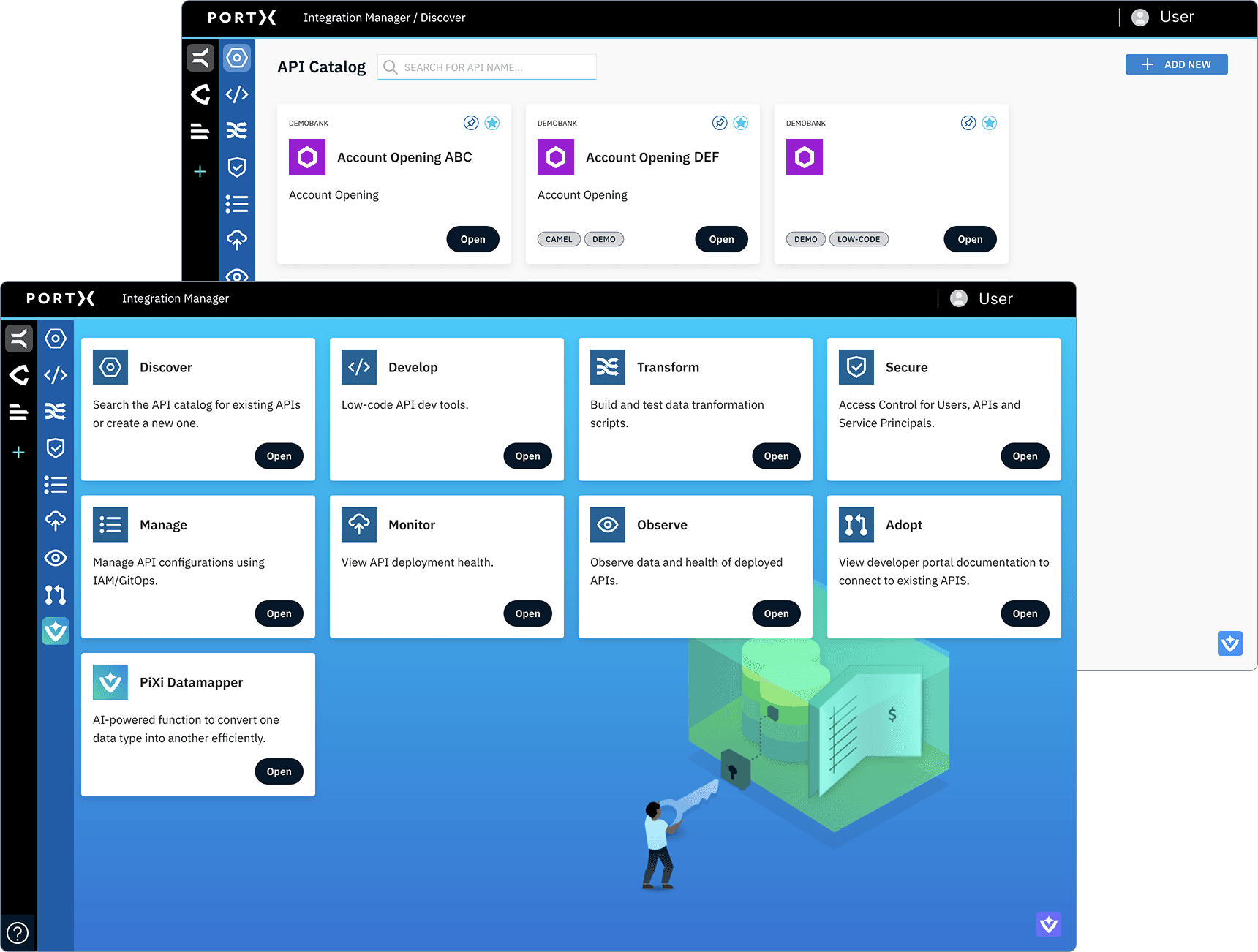
Integration Manager connects blockchain-based rails to core systems and fintech partners
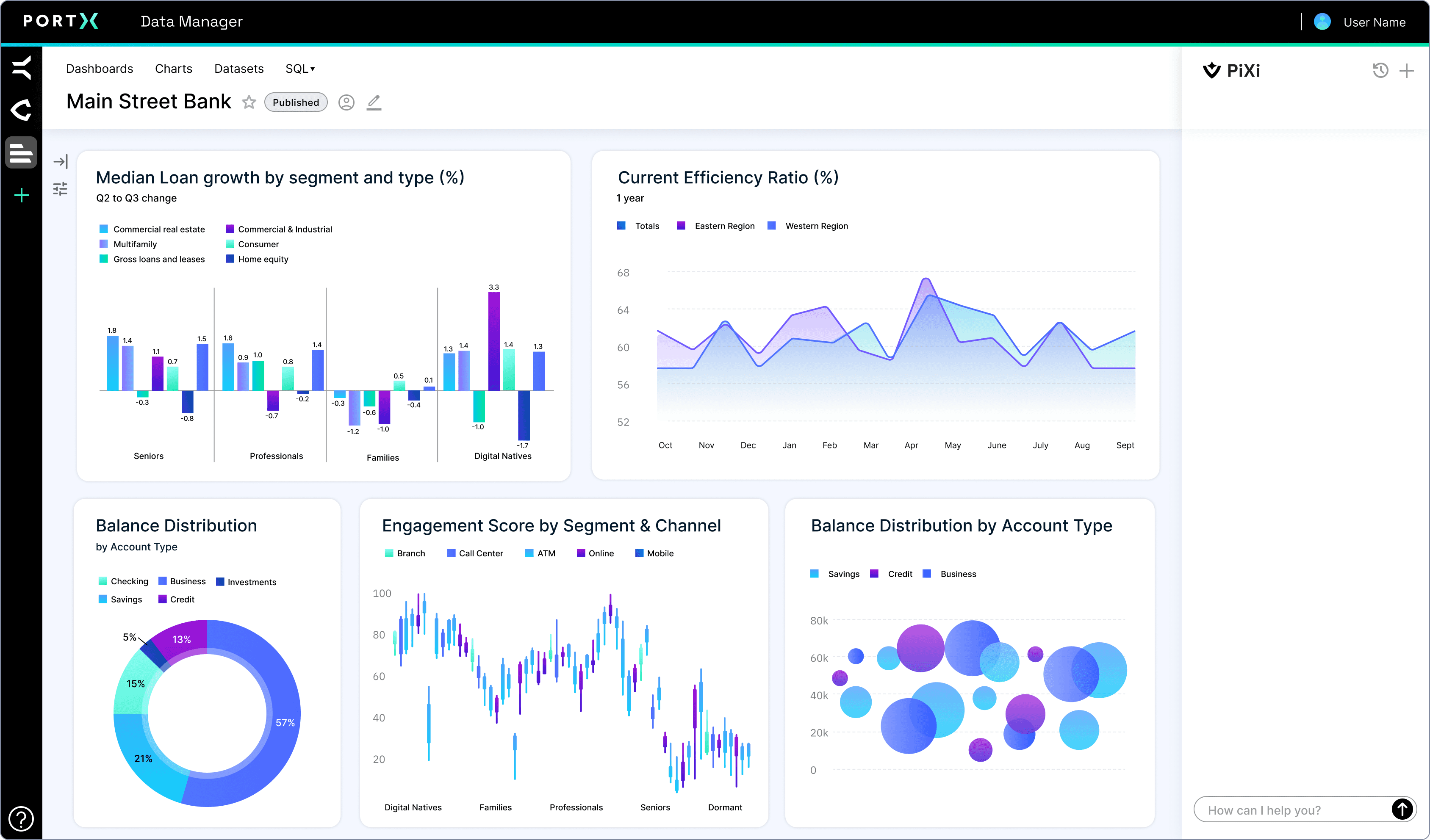
Data Manager delivers real-time insights and governed visibility across transactions
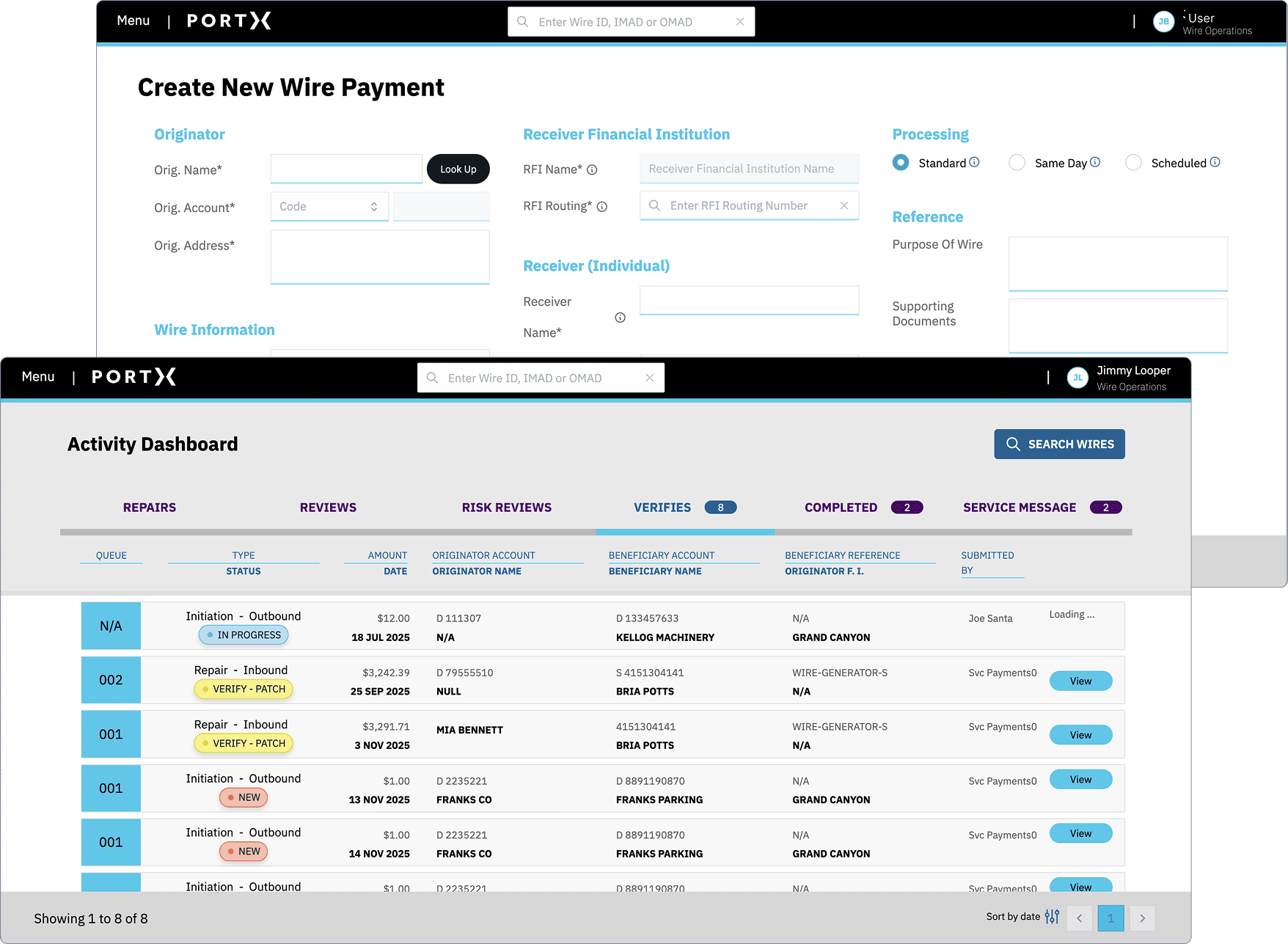
Payment Manager treats stablecoins as another payment rail alongside ACH, wires, RTP, and cards
PiXi AI adds agentic intelligence to automate monitoring, routing, and exception handling
What financial institution leaders should do next
Stablecoins are no longer theoretical. The regulatory framework is set. The technology is proven. The market is moving.
The right next step is not to rush into issuing a coin or launching a consumer product. It is to build readiness.
That means:
Educating leadership teams on stablecoin mechanics and regulation
Identifying payment and settlement use cases where stablecoins create measurable value
Ensuring integration and data foundations can support real-time digital rails
Engaging fintech partners from a position of architectural strength
Banks that start now will shape how their institutions adopt stablecoins. Banks that wait will be forced to react.
Looking ahead
This article sets the stage. In the coming weeks, we will explore how stablecoins reduce payment costs, why they are an opportunity rather than a threat to community institutions, what the GENIUS Act means in practice, and how stablecoin rails integrate with core banking systems.
The promise is real, but so is the risk. Stablecoins can strengthen banks that engage deliberately and weaken those that do not.
Institutions that understand that distinction and act on it will be better positioned for the next era of banking.
If you would like to learn more about how PortX helps financial institutions orchestrate stablecoin-ready integration across Fiserv cores and beyond, start a conversation with our team today.
Join us at:

Financial Brand Forum — Las Vegas, NV
April 13 - 15, 2026
Join us at Financial Brand Forum 2026!
“The future of banking starts here. Proven growth strategies and groundbreaking innovations. Big ideas and actionable insights for banking leaders. The best conference in the banking world. Where banking’s brightest minds come together.
Learn how to tackle your biggest strategic challenges from the industry’s brightest minds at the best conference on growth strategies in the banking world.”
Learn more →

Fintech Meetup — Las Vegas, NV
March 30 - April 1, 2026
Find us at Fintech Meetup!
"Fintech Meetup is the fintech industry’s most productive and anticipated event of the year, where senior leaders from thousands of banks, credit unions, fintechs, and investors come together to connect, collaborate, and drive growth. Powered by breakthrough technology, our Meetings Program delivers 50,000+ double opt-in, one-to-one meetings that spark real partnerships and real ROI.
It’s more than an event, it’s a phenomenon. Fintech Meetup is where the entire fintech ecosystem gathers to discover what’s new, what’s next, and how we’ll shape the future of financial services together."
Learn more →

America's Credit Union GAC — Washington D.C.
March 1-5, 2026
Join us in Washington DC:
Shape the future of credit union advocacy at the largest and most influential government relations conference in the credit union industry. Governmental Affairs Conference (GAC) brings thousands of credit union professionals, policymakers, and system leaders to Washington, D.C., for an experience that drives advocacy and reinforces our commitment to more than 144 million credit union members nationwide.
Following a year of significant wins, including the success of the Don’t Tax My Credit Union campaign, our industry is more energized than ever. Now is the time to build on that success, tell your stories, ignite collective action, and shape what comes next.
Learn more →
If your data had a voice,
what would you ask?