

































PiXi AI
Agentic AI for faster integration and intelligence.
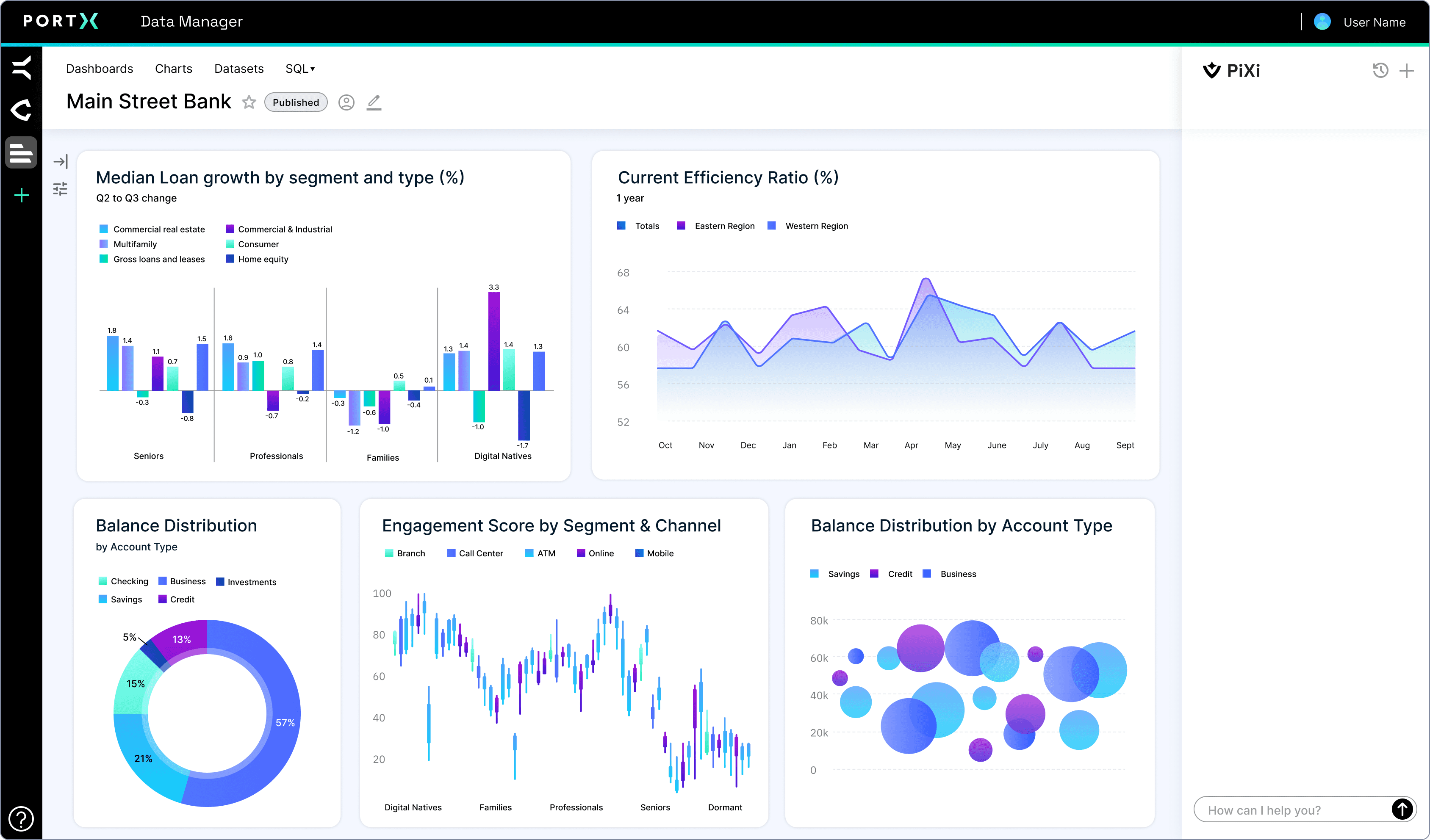
PiXi is the AI foundation of the PortX Platform, giving financial institutions enterprise-grade power without armies of specialists, custom code, or heavy infrastructure. It accelerates integration, simplifies data governance, and delivers instant insights through natural language. Purpose-built for financial services, PiXi ensures secure, compliant, and future-ready intelligence across your institution.
Key Features
Instant trusted insights from natural language queries
AI-powered data mapping cuts project timelines by 40%
Automation and orchestration that streamlines workflow
Compliance-first design that’s secure, governed, and auditable for FIs.
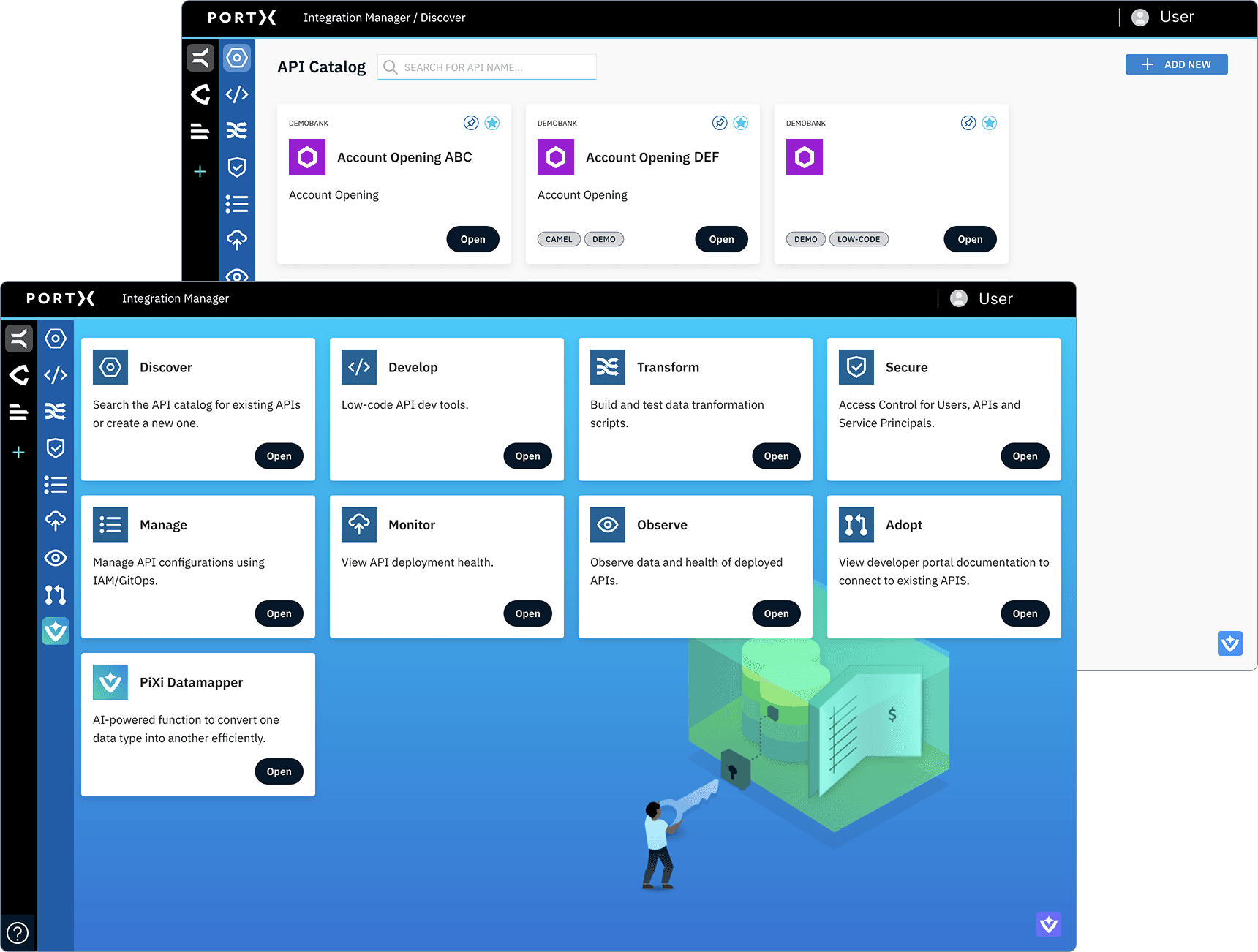
PiXi is embedded across integration, data, and payments.
Key Features
Reusable API Specification – One universal API for common banking use cases.
Portable & Standards-Based – JSON/REST APIs aligned with ISO 20022, CUFX, and FDX.
Compliance & Security – Secure, governed, and auditable access to core data.
ORCA™
Universal, portable connectivity to banking cores.
ORCA™ (Open Reusable Core API) is our universal data model and standardized API specification for connecting financial institutions, fintechs, and applications to core systems. Delivered as part of Integration Manager, ORCA replaces custom, one-off integrations with a single reusable API that works across all major cores. The result: faster fintech adoption, simplified core changes, and reduced risk—powered by consistent, standards-based connectivity.
One platform. One industry. All Use Cases.


Our latest blogs:
Stablecoin Integration for Banks: 7 Steps to Connect Digital Rails to Your Core
Kent Brown
For banks and credit unions, stablecoin integration is no longer a question of if. It is a question of how, and whether your architecture is ready to support it without adding complexity or risk. Over the past four articles, we have built the foundation for this moment. If you are joining us here, here is what you missed:
Stablecoins 101: What Every Bank Leader Needs to Know Post-GENIUS Act — What stablecoins are, what the GENIUS Act changed, and why financial institutions should treat digital money as infrastructure, not speculation.
Digital Money Economics: How Stablecoins and Tokenized Deposits Modernize Bank Payment Rails — Where digital rails create measurable efficiency gains, how they affect liquidity velocity, and why strategic inaction is the real risk.
Stablecoin Regulation for Banking: How Governed Architecture Becomes Competitive Advantage — Why the GENIUS Act raises the bar for governance, and how community banks and credit unions can turn regulatory readiness into a competitive edge.
Tokenized Deposits: The Bank-Led Digital Money Model — Why tokenized deposits may be the most natural entry point into digital settlement for regulated institutions, and what it takes to support them operationally.
What ties these articles together is a single premise: digital money is infrastructure.
That premise demands an execution mindset. Understanding digital rails is not enough. The institutions that lead in this era will be those that integrate deliberately, govern proactively, and build architectures that can extend without breaking.
Step 1: Treat digital money as a payment rail, not a side project
One of the most common mistakes institutions make when approaching digital money is isolating it from core systems. A blockchain pilot lives in innovation. A stablecoin integration runs parallel to core processing.
This fragmentation creates operational risk and governance blind spots. It also guarantees that digital money will never scale.
Stablecoins and tokenized deposits are payment rails. They belong alongside ACH, wires, RTP, and cards in your payments architecture. Routing decisions should be policy-driven. Monitoring should be centralized. Data should flow through the same governed foundation that supports every other payment type your institution processes.
Digital money becomes manageable when it is normalized. That normalization starts with how your organization thinks about it, not just how your systems connect to it.
Step 2: Build an API-led integration layer
Blockchain networks operate outside traditional core systems. Direct point-to-point integrations increase fragility, multiply vendor dependencies, and create the same kind of brittle architecture that has cost financial institutions millions in legacy middleware.
An API-led integration architecture solves this problem by abstracting connectivity through reusable, standardized interfaces. With this approach, institutions can connect to exchanges and digital asset service providers without rewriting core logic, swap service providers without major disruption, apply consistent authentication and security policies across all rails, and maintain centralized governance over access and permissions.
The goal is flexibility without loss of control. The same API-first principles that have accelerated fintech onboarding for forward-thinking institutions apply equally to digital money. Build the abstraction layer once and add rails incrementally as the market develops.
Step 3: Unify real-time data visibility
Digital rails operate continuously. Transactions settle at any hour. Liquidity moves without regard to business day boundaries or batch cutoff windows.
Reconciliation cannot wait until end of day.
Institutions must maintain real-time transaction visibility, on-chain to core ledger reconciliation, unified Customer360 context, role-based access controls, and continuous audit logging. Fragmented data does not just create inconvenience. It creates oversight gaps that regulators and risk committees will not accept.
The institutions best positioned to scale digital money are those that already have a governed, real-time data foundation. If that foundation does not exist today, building it is not a prerequisite for starting the conversation about digital rails. It is a prerequisite for operating them responsibly at scale.
Visibility is the foundation of control. Control is the foundation of trust with regulators, fintech partners, and the board.
Step 4: Embed compliance into architecture
Under the GENIUS Act, stablecoins must comply with reserve transparency and bank-grade KYC, AML, and OFAC requirements. Tokenized deposits operate under existing supervisory frameworks. In both cases, as Article 3 outlined, compliance must operate at digital speed.
The good news for community banks and credit unions is that this is not new territory. The compliance obligations for digital rails mirror what institutions already perform. The difference is operational tempo. Those same KYC, AML, and OFAC checks must now run continuously and in real time rather than within batch windows. Notably, many digital money platforms are beginning to embed these controls natively, which may reduce the implementation burden for institutions that choose their partners carefully. The institutions best positioned to take advantage of that are those that already have a governed integration layer capable of connecting to and extending those built-in controls rather than working around them.
Institutions should ensure automated AML screening is integrated directly into digital rail flows, exception workflows are embedded into payment logic rather than managed manually, real-time transaction monitoring covers on-chain activity alongside traditional rails, and audit trails are unified across systems rather than assembled after the fact.
Manual oversight does not scale in a 24/7 settlement environment. Compliance embedded into architecture does.
Step 5: Orchestrate multiple rails intelligently
Digital money does not replace legacy rails. It expands the options available.
The institutions that capture the most value from digital money will not be those that simply connect to a new rail. They will be those that orchestrate multiple rails within a unified, policy-driven architecture. Stablecoins, tokenized deposits, ACH, RTP, wires, and cards must coexist. Routing logic should evaluate cost, settlement speed, counterparty preference, liquidity availability, and regulatory constraints simultaneously.
This orchestration capability is what prevents fragmentation and preserves the institutional control that community banks and credit unions have always maintained over how money moves on their behalf. It is also what prevents fintech platforms from defining the routing logic and customer interface for your institution by default.
The competitive advantage is not which rail you use. It is whether your institution retains control over how, when, and under what conditions value moves across all of them.
Step 6: Align your liquidity management function with your technical architecture
Digital rails settle faster. That sounds straightforward until you consider what it means for the people inside your institution responsible for making sure the bank always has enough cash on hand to meet its obligations.
In banking, the liquidity management function, which usually falls under the treasury department, is responsible for ensuring the institution can fund its operations day to day. That means monitoring cash flows, managing reserves, and planning for how money moves in and out of the institution across all channels. It is, in essence, the financial command center that keeps the bank solvent and stable.
When payment rails operated in predictable batch windows, treasury teams could plan around those cycles. Digital rails change that. Settlement now occurs continuously. Funds move faster and more frequently. The inflow and outflow patterns that treasury teams have built their monitoring and forecasting models around may no longer reflect how money actually moves.
This is not a reason to avoid digital rails. It is a reason to ensure the teams managing your institution's liquidity are brought into the technical implementation conversation early, not after go-live. The technical architecture that connects your institution to digital rails should be designed to feed real-time data to the people responsible for liquidity decisions, not generate a new set of blind spots for them to manage.
Practically, this means updating intraday liquidity monitoring to reflect continuous settlement, modeling faster inflow and outflow scenarios under both stablecoin and tokenized deposit use cases, and aligning treasury reporting with real-time data rather than end-of-day snapshots.
Digital money adoption without this alignment introduces risk. The institutions that get this right treat it as a cross-functional initiative from day one, not a back-office implementation detail to address after the integration is live.
Step 7: Maintain optionality
The digital money landscape continues to evolve. Interoperability standards are maturing. Regulatory clarity continues to develop through additional legislation beyond the GENIUS Act. New rails will emerge. Existing rails will evolve.
Institutions should avoid locking themselves into a single instrument model or a single integration approach. Supporting both stablecoins and tokenized deposits preserves strategic flexibility. Building on open, extensible integration architecture ensures that future rails can be added without core disruption.
Optionality is a strategic asset. The institutions that build extensible foundations today will not need to make expensive architectural decisions under time pressure tomorrow.
Why architecture determines winners
In every technology cycle, infrastructure determines competitive advantage. Digital money is no different.
Institutions that treat digital money as a narrow product experiment will struggle with scalability and oversight. Institutions that treat it as an architectural evolution will modernize safely, efficiently, and from a position of control.
This is the throughline of this entire series. Stablecoins are infrastructure. Tokenized deposits are infrastructure. The data visibility, compliance automation, and payment orchestration that support them are infrastructure. And the institutions that invest in that foundation, rather than chasing individual use cases in isolation, will be the ones best positioned to lead in the next era of banking.
Integration and data are two sides of the same coin. Solving them together gives institutions clarity, speed, and control in one place.
A final word on readiness
The question we hear most often from bank and credit union leaders is some version of: are we ready for this?
The honest answer is that readiness is not binary. It is a spectrum, and every institution sits somewhere on it today. The goal of this series has not been to argue that every community bank needs a stablecoin strategy by next quarter. It has been to make the case that the institutions which understand the landscape, assess their architectural gaps honestly, and begin building the foundation now will have far more options and far more control than those that wait.
Stablecoins are no longer theoretical. Tokenized deposits are gaining traction in institutional contexts. The regulatory framework is defined and being implemented. The market is moving.
The right response is not urgency for its own sake. It is deliberate readiness. Build the integration foundation. Govern the data. Align the treasury function. Maintain optionality. And engage fintech partners from a position of architectural strength rather than reaction.
That is how community banks and credit unions will lead in the digital money era, not by chasing what is new, but by building what is lasting.
If you would like to learn more about how PortX helps financial institutions integrate stablecoins, tokenized deposits, and traditional payment rails into a unified, governed architecture, start a conversation with our team today.
Tokenized Deposits: A Bank and Credit Union-Led Digital Money Model
Kent Brown
The first three articles in this series established the foundation. We covered what stablecoins are and what the GENIUS Act changed. We examined the economics of digital money and where new rails create genuine efficiency gains. And we made the case that regulatory readiness is not a burden for community banks and credit unions. It is a competitive advantage.
Now we turn to a model that many institutions may find even more natural than stablecoins as an entry point into digital settlement.
Tokenized deposits are traditional bank deposits recorded and transacted on distributed ledger technology. They have received less attention than stablecoins in the broader digital asset conversation, but for regulated financial institutions, they may represent the more immediate opportunity. Unlike stablecoins, tokenized deposits modernize settlement without changing the fundamental nature of bank liabilities. They extend what banks already do rather than asking institutions to navigate unfamiliar regulatory or liability frameworks.
For community banks and credit unions evaluating how to modernize responsibly, understanding tokenized deposits, what they are, how they differ from stablecoins, and where they create the most value, is an essential step in building a digital money strategy that lasts.
What tokenized deposits actually are
Tokenized deposits are issued by regulated banks, held as liabilities on the bank's balance sheet, governed by existing capital and liquidity frameworks, insured within FDIC limits, and integrated into current compliance and reporting mechanisms. In other words, they are deposits in digital form.
The difference lies in how they move. Instead of relying solely on legacy payment rails, tokenized deposits can transact on distributed ledger infrastructure, enabling programmability and near real-time settlement. A corporate treasury team can move funds between institutions with the speed and finality of a blockchain transaction while the underlying liability remains classified exactly as it always has been. The innovation is in the rails, not the instrument.
That distinction is what makes tokenized deposits particularly relevant to regulated institutions. The liability classification remains unchanged. The supervisory treatment remains familiar. The operational benefits are real.
Why this matters structurally
Articles 2 and 3 examined stablecoins through an economic and supervisory lens. Tokenized deposits bring a different structural profile that deserves its own consideration.
Stablecoins are typically liabilities backed by segregated high-quality liquid assets, pegged to the dollar, and restricted from issuer-paid yield. Their stability depends on reserve transparency, liquidity management, and market confidence. They sit adjacent to deposit structures rather than within them. Tokenized deposits, by contrast, are direct claims on a regulated bank.
This structural difference has meaningful downstream effects. Capital treatment, liquidity classification, supervisory reporting, balance sheet strategy, and funding stability all behave differently depending on whether an institution is working with stablecoins or tokenized deposits. For a CFO modeling long-term funding composition, or a chief risk officer evaluating new product approval, those differences shape timelines, approval processes, and board conversations.
For institutions concerned about deposit substitution risk or funding volatility, tokenized deposits preserve continuity. They do not create a parallel liability category. They digitize an existing one.
Intended use cases
Tokenized deposits are particularly well suited for institutional and interbank applications where legacy rails introduce friction without adding value.
Near-term institutional applications
Examples include interbank settlement, wholesale and treasury payments, corporate liquidity management, regulated financial market infrastructure, and clearing and settlement of tokenized securities. In each of these contexts, the combination of near real-time settlement and familiar balance sheet treatment is not just convenient. It is architecturally appropriate.
Consumer-facing applications may come in time, but the near-term opportunity for most community banks and credit unions lies in back-office and institutional use cases where settlement speed and programmability translate directly into cost reduction and operational efficiency.
Stablecoins and tokenized deposits can coexist
The conversation is often framed as a choice between stablecoins and tokenized deposits. That framing is incomplete.
Stablecoins may excel in open ecosystem interoperability, cross-border flows, and fintech-driven payment experiences. Tokenized deposits may dominate regulated institutional contexts where balance sheet alignment and supervisory clarity are paramount. They offer a lower-friction path for institutions that need to modernize settlement mechanics without navigating new liability frameworks.
Institutions that understand both models retain flexibility. The strategic advantage lies in orchestration, not selection. The goal is not to pick a winner. It is to build the architectural foundation that allows you to support both as the market continues to develop.
Regulatory familiarity as a fast-track to adoption
Tokenized deposits operate within well-established supervisory frameworks. That familiarity reduces ambiguity for boards of directors, risk committees, regulators, and external auditors. Institutions do not need to reinterpret liability categories or seek novel regulatory guidance. They extend existing frameworks into digital form.
Why familiarity accelerates timelines
New product approvals move faster when examiners and risk committees are working within familiar territory. Legal review is more straightforward. Board education requires less groundwork. For institutions that want to move quickly, regulatory familiarity is not a consolation prize. It is a genuine accelerant.
For more conservative institutions, or those earlier in their digital modernization journey, this continuity may be the most important factor in determining where to start.
The competitive case for leading with tokenized deposits
The competitive threat in digital money is not which instrument becomes dominant. It is losing control of digital money orchestration.
Fintech platforms are building programmable payment flows that abstract complexity from end users. Routing logic, wallet experiences, and settlement decisions are increasingly being defined at the application layer, not the institutional layer. If banks do not define their digital money strategy, fintechs may define it for them.
Tokenized deposits give banks an opportunity to lead from a position of structural strength. They allow institutions to enter the digital settlement space using regulatory frameworks they already understand, engage fintech partners from a position of architectural confidence, and modernize without ceding balance sheet control or funding classification.
This is not a defensive posture. It is a deliberate one. Banks that move intentionally on tokenized deposits are not playing catch-up. They are establishing the infrastructure advantage that will matter as digital money adoption accelerates.
Operational requirements
Tokenized deposits still require integration discipline. Institutions must ensure secure connectivity to distributed ledger infrastructure, real-time reconciliation between on-chain records and core systems, continuous monitoring and transaction visibility, role-based access controls, and unified reporting across digital and traditional rails.
Architecture is a prerequisite to scale
Settlement becomes faster, but the governance requirements around that settlement become more demanding, not less. The same KYC, AML, and OFAC checks your institution already performs must now operate continuously and at digital speed rather than within batch windows. Monitoring must operate continuously. Reconciliation cannot wait for end-of-day batch cycles. Audit trails must be unified across on-chain and off-chain records.
The institutions best positioned to adopt tokenized deposits are those that have already invested in unified integration and governed data foundations, precisely the readiness questions Article 3 outlined. Architecture is not a prerequisite to start the conversation. But it is a prerequisite to scale.
Strategic outlook
Tokenized deposits may ultimately see broader adoption among regulated institutions than open stablecoin models. They align naturally with traditional funding structures, preserve supervisory clarity, and modernize settlement without redefining liability categories. For community banks and credit unions, they represent a credible path into the digital money era that does not require a fundamental rethinking of how the institution operates.
Stablecoins remain important. They expand ecosystem interoperability and enable cross-border efficiency that tokenized deposits are not designed to replicate. The most resilient institutions will build the capability to support both and route intelligently based on use case, cost, counterparty preference, and regulatory context.
The question is not stablecoins or tokenized deposits. It is whether your architecture can support either, and what it actually takes to integrate digital rails into core systems without adding complexity or risk. That is exactly what the final article in this series addresses.
If you would like to learn more about how PortX helps financial institutions enter the digital settlement era through unified integration and governed data, start a conversation with our team today.
Stablecoin Regulation for Banking: How Governed Architecture Becomes Competitive Advantage
Kent Brown
With the passage of the GENIUS Act, payment stablecoins moved from regulatory ambiguity into a defined federal framework. Reserve requirements, disclosure standards, compliance expectations, and restrictions on issuer-paid yield now shape how stablecoins operate in the United States.
Additional details continue to evolve through related digital asset legislation, including the Digital Asset Market Clarity Act of 2025. The direction is clear, even if certain lines are still being refined.
For banks and credit unions, this is a meaningful shift.
Digital money is no longer confined to operating at the edge of the regulated system. It is increasingly being embedded into it.
But regulatory clarity does not eliminate operational complexity. It raises the bar for governance, integration discipline, and real-time oversight. Article 2 examined the economics. This article focuses on what comes next: the supervisory structure, risk considerations, and architectural discipline required to operationalize digital rails with confidence.
What the GENIUS Act establishes
At a high level, the GENIUS Act requires payment stablecoins to:
Maintain one-to-one reserve backing with high-quality liquid assets such as cash and short-term Treasuries
Provide regular public disclosures and reserve audits
Comply with bank-grade KYC and AML requirements
Support lawful enforcement controls, including freezing or burning tokens under court order
Avoid issuer-paid yield as part of the stablecoin design
The intent is straightforward. Stablecoins are positioned as payment instruments, not investment vehicles or deposit substitutes.
Token holders may still earn yield through third-party arrangements, but the issuer does not pay that yield.
This structure reduces the likelihood that stablecoins directly compete with FDIC-insured savings products. It reinforces their primary function as a settlement mechanism.
For executives, the takeaway is this: stablecoins are now regulated infrastructure. That makes them more viable. It also makes them more accountable.
Stability, confidence, and liquidity management
Reserve backing is essential. It is not sufficient on its own.
Stablecoins are designed to be pegged to the U.S. dollar. In practice, pegs can experience short-lived deviations based on market confidence and liquidity dynamics. Well-regulated issuers mitigate this through transparent reserve reporting and disciplined liquidity management.
From an institutional perspective, confidence is the critical variable.
If redemption demand rises suddenly, liquidity planning determines whether the peg remains stable. Institutions interacting with stablecoins must understand:
Counterparty reserve composition
Redemption mechanisms
Intraday liquidity exposure
Transaction velocity monitoring
The GENIUS framework reduces structural fragility compared to unregulated models. It does not remove the need for active risk management.
For CIOs and risk leaders, this is an architectural consideration. Monitoring must be real-time. Reconciliation must be automated. Visibility must extend across systems.
Continuous settlement requires continuous oversight
Traditional payment rails operate within predictable windows. Batch processing and cutoff times create natural review intervals.
Stablecoins operate continuously.
Transactions can settle at any hour. Liquidity moves without regard to business day boundaries. Monitoring cannot rely on end-of-day reconciliation.
Institutions must ensure:
Real-time transaction visibility
Automated AML screening
Unified audit trails
Integrated compliance reporting
Digital rails do not slow down for governance. Governance must operate at digital speed.
This is where integration and data become inseparable from compliance.
Supervisory contrast: stablecoins and tokenized deposits
Understanding regulatory structure is critical for strategic positioning.
Stablecoins operate under reserve-backed issuer requirements. They are typically liabilities backed by segregated high-quality assets. Their supervisory focus centers on reserve adequacy, transparency, and redemption discipline.
Tokenized deposits operate under traditional deposit supervision. They remain on the bank's balance sheet, fall within existing capital and liquidity frameworks, and are insured within FDIC limits.
This difference matters for boards and regulators.
Stablecoins modernize payment rails through reserve-backed digital tokens. Tokenized deposits modernize settlement while preserving traditional liability classification.
Both models require oversight. They do so under different supervisory constructs. Article 4 explores tokenized deposits in depth, including why many community institutions may find them to be the more natural starting point.
Regulatory readiness as competitive advantage
Community banks and credit unions already operate within rigorous supervisory frameworks. That experience is not a burden in the digital era. It is an asset.
Institutions that embed compliance into integration architecture can:
Reduce operational risk
Accelerate innovation
Demonstrate control to regulators
Build trust with fintech partners
Digital money does not reward improvisation. It rewards disciplined architecture. And institutions that have spent years building compliance muscle are better positioned than they may realize.
The question is not whether community banks can compete in the digital money era. It is whether they can act on the structural advantage they already have.
Are you architecturally ready?
Before engaging with digital rails, institutions should honestly assess their current foundation:
Integration and data visibility. Can you monitor transactions across all payment rails in real time with unified, governed access to that data across systems, or do you rely on batch reconciliation, end-of-day reporting, and multiple disconnected sources to piece together a complete picture?
Compliance automation. Are AML screening and exception workflows embedded into your payment logic, or are they manual processes that would not scale to 24/7 settlement?
Extensibility. Can your current integration architecture add a new payment rail without a major rewrite of core logic?
Institutions that can answer yes to all three are well-positioned to move quickly. Those with gaps have a clear roadmap for where to invest before digital money becomes operationally urgent.
Interoperability and evolving standards
Digital asset regulation continues to evolve globally. Jurisdictional differences persist. Interoperability between public and permissioned networks remains in development.
Executives should expect continued refinement of:
Reporting standards
Cross-border supervisory coordination
Digital asset custody frameworks
Technical integration guidelines
The regulatory trajectory favors clarity and integration rather than prohibition. Institutions that build flexible, open architectures will adapt more easily as standards mature.
Architecture as risk control
Compliance in the digital money era is not a static checklist. It is a systems design challenge.
Institutions need platforms that unify:
Integration across blockchain and traditional rails
Real-time data visibility
Role-based access controls
Automated monitoring and exception handling
When integration and data are fragmented, oversight becomes reactive. When they are unified, governance becomes proactive.
The executive perspective
Regulation has moved stablecoins from ambiguity into structure. Tokenized deposits provide a bank-native digital alternative. Both models are increasingly relevant.
The opportunity is real. The responsibility is greater.
Institutions that understand supervisory nuance, embed governance into architecture, and maintain control over integration will modernize safely.
Those who treat digital rails as peripheral may struggle to scale responsibly.
Digital money is not outside the regulated system. It is becoming part of it. And the institutions with the strongest compliance foundations are the ones best equipped to lead.
In our next article, we’ll examine tokenized deposits in depth and explore why many banks and credit unions may see them as the most natural path into blockchain-based settlement.
If you would like to learn more about how PortX helps financial institutions build regulated, digital-ready architectures, including governed integration and real-time compliance visibility across all payment rails, start a conversation with our team today.
Join us at:

Fiserv Signature Users Conference
April 13 - 16, 2026
"The Signature Conference is your annual conference featuring over 40 breakout sessions, a vendor showcase, and best practices.
This year marks our 40th anniversary with the theme:

As the financial world evolves, it’s essential to stay informed about Fiserv’s Banking Software solutions and adapt to new technologies. The conference offers valuable opportunities for learning, networking, and sharing strategies to help financial institutions thrive."
Learn more →

Financial Brand Forum — Las Vegas, NV
April 13 - 15, 2026
Join us at Financial Brand Forum 2026!
“The future of banking starts here. Proven growth strategies and groundbreaking innovations. Big ideas and actionable insights for banking leaders. The best conference in the banking world. Where banking’s brightest minds come together.
Learn how to tackle your biggest strategic challenges from the industry’s brightest minds at the best conference on growth strategies in the banking world.”
Learn more →

Fintech Meetup — Las Vegas, NV
March 30 - April 1, 2026
Find us at Fintech Meetup!
"Fintech Meetup is the fintech industry’s most productive and anticipated event of the year, where senior leaders from thousands of banks, credit unions, fintechs, and investors come together to connect, collaborate, and drive growth. Powered by breakthrough technology, our Meetings Program delivers 50,000+ double opt-in, one-to-one meetings that spark real partnerships and real ROI.
It’s more than an event, it’s a phenomenon. Fintech Meetup is where the entire fintech ecosystem gathers to discover what’s new, what’s next, and how we’ll shape the future of financial services together."
Learn more →
If your data had a voice,
what would you ask?